
When the Energy Rises: Simple Tools for the Hardest Moments
How Kind Mind helps children move through change with more calm, confidence, and connection
The end of the school year can feel like a celebration, but it can also bring a lot of emotion into the classroom.
Children may be saying goodbye to teachers they love. They may be preparing for a new classroom, a new school, a summer schedule, a different caregiver, or days with less structure than they are used to. Even exciting transitions can create uncertainty, and uncertainty often shows up as big feelings.
More tears. More movement. More conflict. More difficulty listening. More moments when the energy in the room seems to rise all at once. In those moments, children are not trying to make the day harder. Their nervous systems are asking for support. That is where Kind Mind helps.
Before children can calm, they need to feel safe
One of the most important shifts in social-emotional learning is moving away from “calm down” and toward connection, co-regulation, and emotional awareness. Kind Mind’s approach reflects this deeper understanding: the goal is not to make emotions disappear. The goal is to help children recognize what they are feeling, feel supported by steady adults, and practice tools that help them move through the moment.
Kind Mind gives educators a shared language and practical routines that fit into the rhythm of the day. The program is built for real classrooms, with short videos, ready-to-use materials, visuals, and daily touchpoints that help teachers support regulation without adding something overwhelming to their plates.
Simple tools for high-energy moments
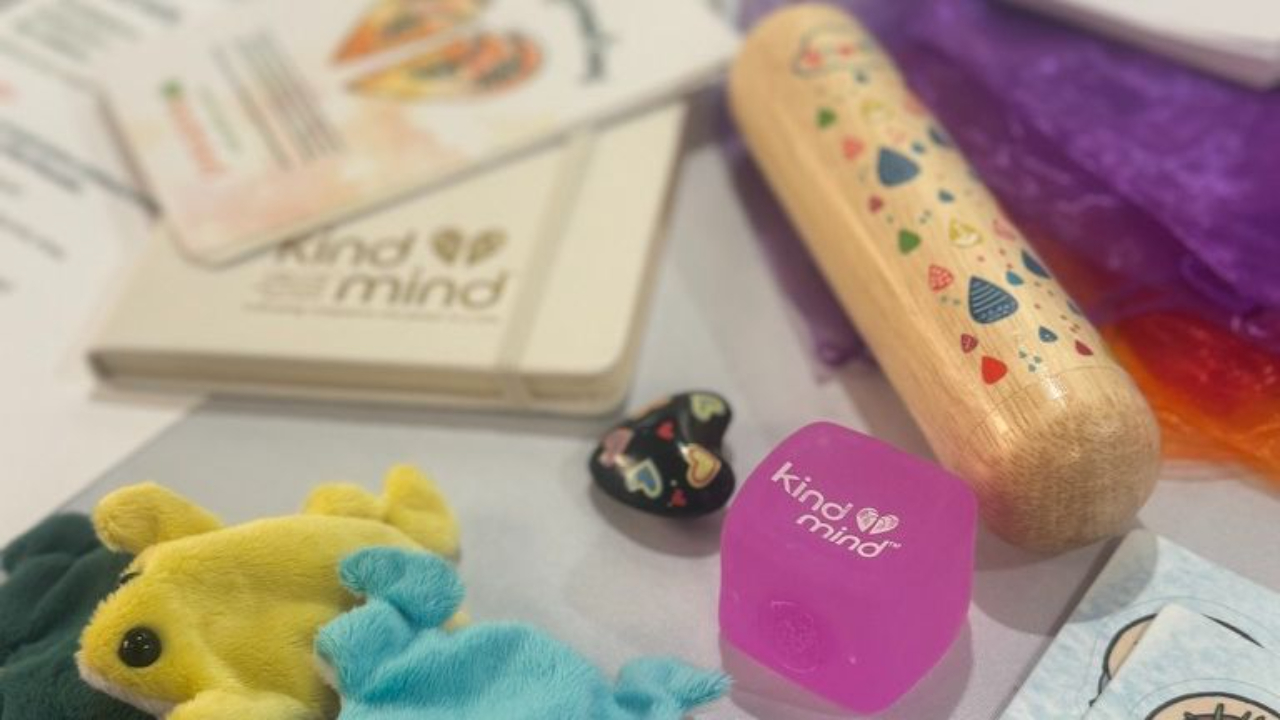
When emotions rise, teachers need tools they can reach for quickly. Kind Mind supports classrooms with concrete practices that help children pause, notice, move, breathe, and reconnect.
These tools may include:
- Visual cues: Pictures, posters, and classroom visuals give children something concrete to look at and return to. Visuals can be especially helpful when language is hard to access in a big-feeling moment.
- Breathing practices: Simple breathing tools help children slow down and reconnect with their bodies. Kind Mind educators have reported seeing children use breathing strategies in the classroom before calling for adult help.
- Movement breaks: Sometimes, regulation does not begin with stillness. Children may need to move their bodies before they can settle. Movement scarves, songs, and guided activities can help shift energy in a safe and purposeful way.
- Emotional check-ins: Naming feelings helps children build emotional awareness. Kind Mind’s blog emphasizes that acknowledging and naming emotions can reduce their intensity and help children understand emotions as information rather than disruptions.
- Predictable routines: Arrivals, transitions, group time, meals, rest, and goodbyes all become opportunities to practice regulation. Kind Mind helps teachers establish daily rhythms with small touchpoints that fit into routines already happening in the classroom.
Change is easier when children know what to expect:
Transitions are often hardest when children do not know what comes next. A predictable beginning, a familiar song, a calming object, a visual cue, or a repeated phrase can become an anchor.
At Red Clover Children’s Center in Vermont, Kind Mind has helped educators build a culture of co-regulation through shared values, consistent routines, visuals, and tools teachers can use throughout the day. The center has leaned into intentional rituals like greeting children, gathering on the floor, creating community, and using predictable beginnings and endings to help children feel grounded.
Those small moments matter. They tell children: You are safe. You are seen. We know what to do when things feel big.
Supporting teachers supports children
When classroom energy rises, educators need support, too. Kind Mind begins with the adults because children borrow calm from the people around them. As one Kind Mind blog notes, “If we’re not regulated, they’re not regulated.”
That does not mean teachers have to be perfectly calm all the time. It means they deserve tools, language, and routines that help them feel more prepared in the moments that ask the most of them.
Back to center, one small practice at a time
The hardest moments in a classroom are often the moments when children need connection most.
With shared language, visual supports, calming tools, and predictable routines, Kind Mind helps teachers meet those moments with more confidence and compassion. Over time, children begin to learn that big feelings can be named. Energy can shift. Change can be handled. And calm is something we can practice together.
That is the work of regulation. Not perfect days. Not quiet children. Just supported adults, connected classrooms, and simple tools that help everyone come back to center.
Author