
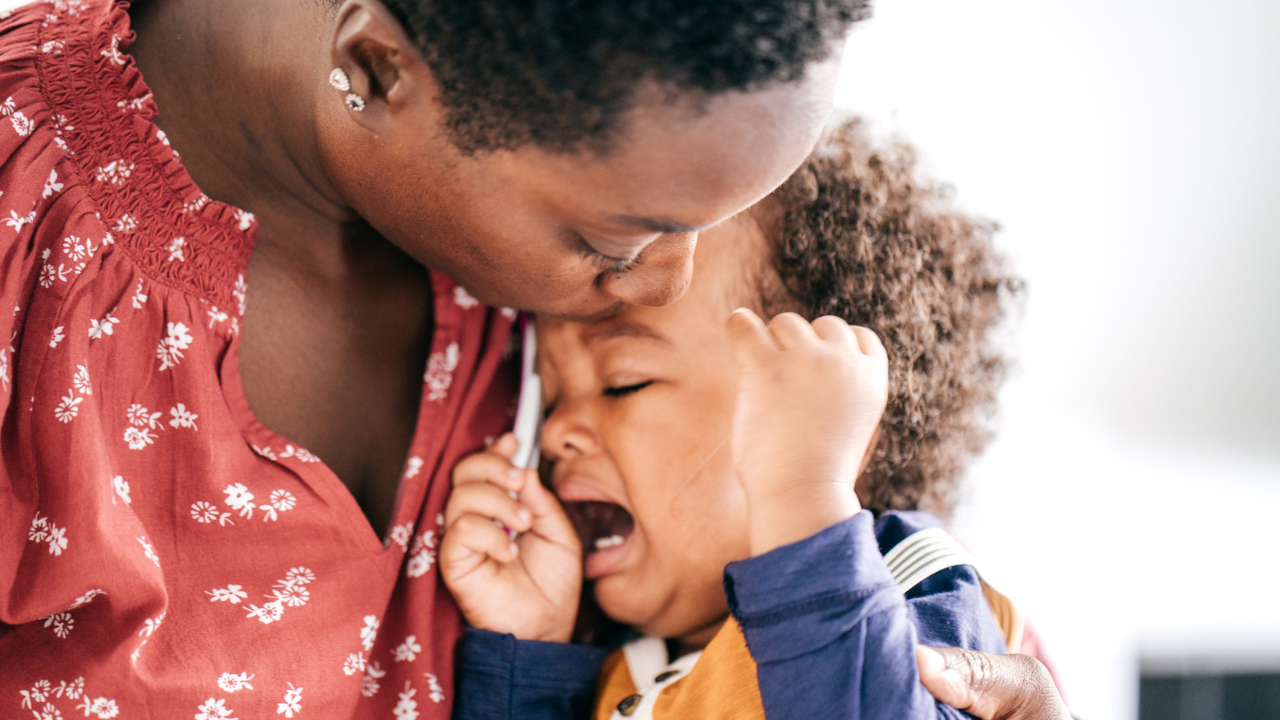
7 Steps to Handle Preschooler Tantrums: A Trauma-Informed Guide for Parents
It's 5:15 on a Tuesday. You cut the toast into triangles, but your four-year-old wanted squares. Now they're flat on the kitchen floor, red-faced and shrieking, and you're standing there with the butter knife wondering how toast became the hardest part of your day.
If you've ever asked yourself, "Why does my preschooler have so many tantrums?", you are in very good company. Most parents ask it at some point. Under that question sit a few heavier ones. Is this normal? Am I doing something wrong? Is something wrong with my child?
Here is the short answer. Tantrums are a normal part of early childhood, and they are not a sign of bad parenting or a bad kid. They show up when a young child has very big feelings and not yet enough skills to manage them. The encouraging part is that your response matters, and it is something you can practice.
This guide explains why preschooler tantrums happen, what is typical at ages 3 to 5, and how a trauma-informed lens can change the way you see a meltdown. It then walks through seven calm steps you can try this week. It also covers the signs that a child may need extra support, because knowing when to ask for help is part of good parenting too.
Why Does My Preschooler Have So Many Tantrums?
Picture a traffic jam inside a very small body. Feelings arrive fast and strong, and the skills that would help a child slow down, wait, and find words are still being built. Children are not born with self-regulation skills. They are born with the potential to build them, and those skills keep maturing through the teen years and into early adulthood. A preschooler is near the very start of that road.
Everyday pressures can tip the system over quickly. Young children may not have the vocabulary to describe what they feel, and tiredness, hunger, crowded places, and exciting events all make calming down harder. Some children also have temperaments that make them react more intensely. Tantrums are a normal part of development, and they tend to peak when a child is hungry or tired.
Tantrums also have a job to do. They are a normal way for young children to release intense emotional energy and return to calm. Young children also often have tantrums as a way to get their needs met. That is not the same as plotting against you. A tantrum is usually a clumsy, loud way of saying, "I need help and I don't know how to ask."
What Preschooler Tantrums Look Like at Ages 3, 4, and 5
Tantrums are most common between about ages 1 and 3. They usually ease as children gain language, but they do not switch off on a third birthday.
In a 2012 study funded by the National Institute of Mental Health, researchers at Northwestern University and the University of Connecticut Health Center surveyed parents of about 1,500 children aged 3 to 5. More than 80 percent of the children had at least one tantrum in the past month. Fewer than 10 percent had them every day.
Occasional tantrums at this age are the norm, not the exception. Researchers described daily tantrums, or tantrums with severe behaviors such as aggression or destruction, as unusual and possibly a sign of a larger problem.
Older preschoolers often have more words to work with, but a meltdown can knock those words right out of reach, even for a talkative five-year-old.
Seeing Tantrums Through a Trauma-Informed Lens
Trauma-informed care starts with one change in question. Instead of "What's wrong with this child?" we ask, "What does this child need right now?" That small shift moves us from managing a behavior to understanding the feeling underneath it.
It helps to be clear about what this does and does not mean. Most tantrums are not a sign of trauma. They are a normal part of growing up. But some children are carrying more than their share of stress, such as a move, a new baby, a separation, a loss, a frightening event, or ongoing instability at home. Young children often cannot put fear or helplessness into words, so it shows up in how they act. Clinginess, trouble being consoled, aggression, sleep problems, and acting younger than usual can all be signs of a child under stress.
Here is the hopeful part. A reliable, caring caregiver is a key protective factor for a child, and caregivers help by regulating a child's strong emotions and reassuring them that adults are working to keep them safe. So the steady way you respond to a tantrum is not just crowd control. It is part of how a child learns that big feelings can be survived and that the people who love them stay steady.
That is co-regulation: your calm helps their nervous system borrow calm until they can build their own. At Kind Mind we call this a regulation-first approach, because children have a hard time listening or solving problems until their bodies feel safe again.
7 Steps to Handle Preschooler Tantrums With Calm
You do not need to do all seven perfectly, or in order, in the middle of a meltdown. Think of them as a toolkit. Start with the first step and add the others as they begin to feel natural.
Step 1: Steady Your Own Body First
A child in the middle of a tantrum is looking for a calm nervous system to borrow, so the first job is yours. Helping a child with big emotions starts with calming your own, because children imitate us. A parent who pauses and manages their own feelings is modeling self-regulation in real time.
Try a quick body scan. Feel your feet on the floor. Drop your shoulders. Unclench your jaw. Let out one slow breath, a little longer than the breath in. It takes about ten seconds and can change the tone of everything that follows. If you feel yourself about to blow, it is okay to take a break or hand your child to another adult, as long as your child is safe.
Step 2: Keep Everyone Safe and Stay Close
Safety comes first. Make sure your child cannot hurt themselves or anyone else, and move anything breakable out of the way. If your child is in danger, for example near a street, hold them firmly. Otherwise, stay calm and nearby without crowding them. Your presence says, "You are not alone with this feeling."
Some children want a hug in the middle of a meltdown, and others need space first. Gently holding a child can help when they seem more upset than angry, as long as you feel calm enough to reassure them. Follow your child's lead. If touch makes things worse, simply sit close and stay quiet.
Step 3: Notice and Name the Big Feeling
When you can, put words to what you see. The steps are simple: notice the feeling, connect through eye contact or a gentle touch, listen with a calm tone, and name the emotion. You might say, "You're so mad. You wanted the red cup and it's in the dishwasher."
Naming the feeling helps a child link what they feel, what is happening in their body, and the words for it. It also tells them the feeling is allowed. Keep it short. A child in the middle of a meltdown cannot take in a speech, and rushing to fix the problem can brush past the feeling and make things escalate.
Naming a feeling is not the same as giving in. You can say, "You really want to stay at the park, and you're so disappointed," and still walk to the car.
Step 4: Pause and Wait
This is the hardest step for many adults, because it feels like doing nothing. It is actually doing a lot. Stay quiet for a few seconds after naming the emotion, which gives your child time to process. They may calm down or even find their own solution.
Instructions like "use your words" or "take deep breaths" often don't work until a child has already settled. So keep your own breathing slow, stay close, and wait. Once everyone is safe, staying calm and letting the tantrum pass on its own is often the best move. Your steady body is doing the co-regulating.
Here is what this can look like in a preschool room. This is a composite, not a real child. Four-year-old Sam throws the blocks when it's time to tidy up. His teacher doesn't raise her voice. She crouches nearby, takes a slow breath, and says quietly, "You're so frustrated. You weren't finished building." Then she waits. After a minute, Sam's shoulders drop. "I won't let you throw blocks," she says. "Want to help me carry the box?" Sam nods. Nothing about it was dramatic, and that's the point. The teacher didn't win. She stayed steady until Sam could borrow enough of her calm to find his own.
Step 5: Hold the Limit With Warmth
All feelings are welcome. Hurting is not. A helpful way to hold it: all emotions are acceptable, not all behaviors are. After you have named the feeling, set a clear limit on hurtful behavior and offer a simple alternative, such as, "You can stomp your feet or squeeze this pillow. I won't let you hit."
Do not let hitting, kicking, biting, or throwing slide. Step in right away to stop it. Holding your position on "no" matters too, because giving in or offering bribes teaches a child that tantrums work.
A common misconception is that warm, feelings-first parenting means never saying no. A regulation-first approach is not permissive. It is calm and consistent, and it keeps the limit and the love in the same sentence.
Step 6: Reconnect and Repair Afterward
Once the storm has passed, the learning begins. Teaching works best when everyone is safe and calm, not in the middle of distress. Start with comfort: a hug, a drink of water, a few minutes with a picture book.
Then keep the conversation brief. "That was a big feeling. You were so mad about the cup. Next time you can tell me, 'I'm mad,' or ask for a squeeze." Once your child is calm, suggest healthier ways to express the emotion and set clear limits where they're needed.
Repair goes both ways. If you lost your temper, you can say so: "I yelled, and that wasn't okay. I'm sorry." This shows your child that mistakes can be fixed and that your relationship is still safe.
Step 7: Prevent the Next Storm
You cannot prevent every tantrum, but you can lower the odds. Plan around hunger and tiredness by carrying snacks and protecting nap time. Offer small choices instead of yes-or-no questions, give plenty of attention and specific praise when your child is doing well, and pick your battles while staying consistent from day to day.
Practice big feelings when everyone is calm. Read stories about feelings, name emotions during play, and try the body scan together. A calm-down routine is easier to reach for in a hard moment if you have practiced it on easy days. Gentle music can help, too. A familiar, quiet song often becomes a signal that it's time to settle, in classrooms and at home alike.
When Preschooler Tantrums Need Extra Support
Most tantrums are part of typical development. Still, some patterns are worth raising with a professional. Researchers describe daily tantrums as unusual, along with tantrums involving aggression or destruction, such as hitting, biting, kicking, or breaking things. Tantrums that last an unusually long time, or that regularly seem to come out of nowhere, are also less typical.
No single sign means something is wrong. What matters is the pattern: how often tantrums happen, how intense they are, and how much they get in the way of daily life. Researchers also say more work is needed to pinpoint exactly when young children benefit from specialized support.
It is also worth checking in if your child has been through something stressful or frightening and you notice big changes in behavior, sleep, or mood. Clinginess that won't ease, losing skills they had recently gained, and physical complaints like stomachaches are among the signs of stress in young children. Children with ADHD, and autistic children who show aggression, may also need extra professional support.
Who should you ask? In the US and Canada, a pediatrician is a good first call if you are concerned about your child's tantrums or behavior. In the UK and Australia, a GP can refer families to counselors or psychologists, and parenting programs are another option.
Asking for help is not a verdict on your parenting. It is the same instinct that makes you check on a fever.
Why Your Preschooler Has Tantrums, and Why You're Not Failing
If you take one idea from this guide, let it be this. When you wonder why your preschooler has so many tantrums, the answer is rarely "because I'm doing it wrong." It's usually that a small person has big feelings and a brain that is still learning how to hold them. Your job is not to stop every storm. It's to be the calm they can borrow until they can make their own.
Each time you take a breath before you respond, name a feeling, hold a kind limit, and repair afterward, you are teaching your child something they will use for the rest of their life.
At Kind Mind, we build evidence-based Social Emotional Learning practices for early childhood classrooms and the families who support them. Kind Mind has earned CASEL's highest designation for high-quality SEL programming! We're officially a CASEL SELect program! If you'd like practical resources for the grown-ups who care for young children, you're welcome to explore our programs and parent resources at your own pace.
Author