The Power is in the Consistency: Kind Mind at Presumpscot Elementary
At Presumpscot Elementary, Kind Mind has become a familiar classroom rhythm children can trust, use, and carry into hard moments.
At Presumpscot Elementary School in Portland, Maine, Kind Mind has become something children know, expect, and count on.
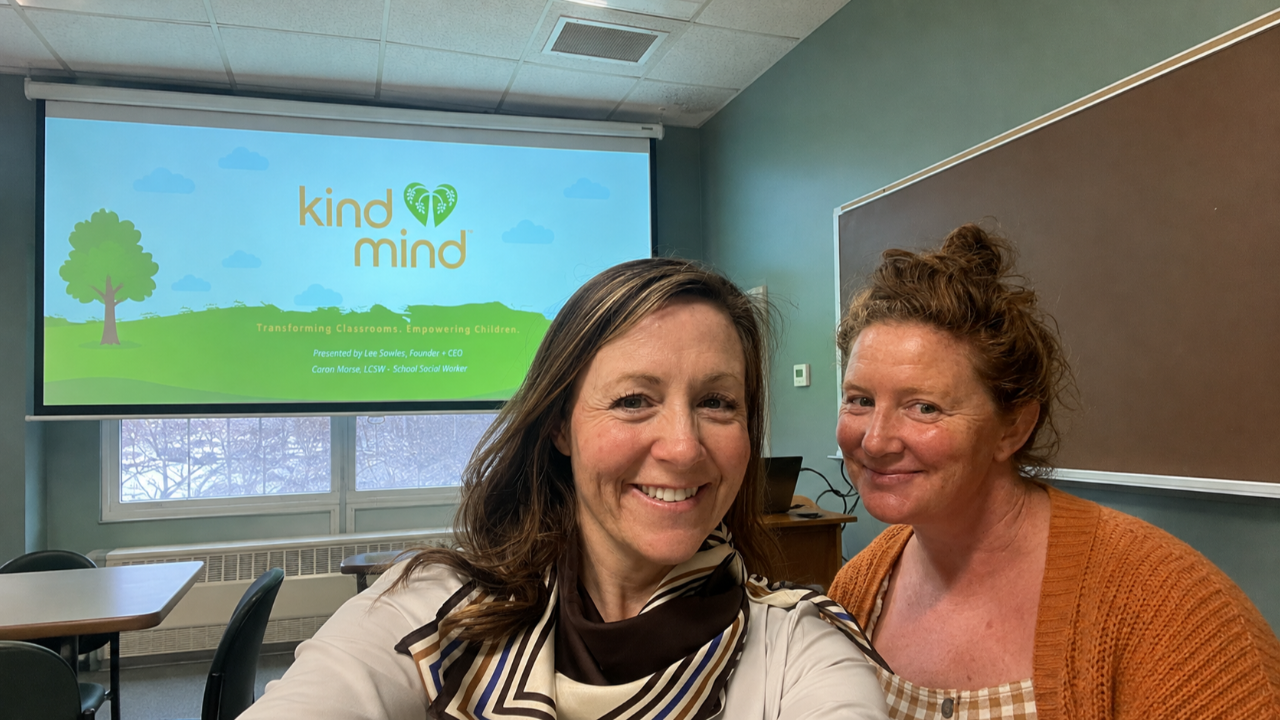
For Caron Morse, LCSW, the school social worker at Presumpscot, that matters. Presumpscot serves about 250 students in pre-K through fifth grade, and Caron is the only mental health provider in the building. Her role is broad, supporting students with IEPs, teacher and parent referrals, students experiencing housing instability, and classroom-based social-emotional needs.
Before Kind Mind, Caron was already looking for a way to reach more students — not only the children on her caseload, but all children, in the natural context of their classrooms. She had been creating her own version of a classroom meeting, but it did not yet have the structure, materials, or rhythm she wanted.
Kind Mind gave that work a name, a framework, and tools she could use consistently.
“It was the simplicity of it,” Caron said. “It just felt manageable.”
A rhythm children can trust
Caron has adapted Kind Mind in a way that fits the realities of her school. Each year, she works with about half of the classrooms from September through December and the remaining classrooms from January through May. Each class receives Kind Mind once a week for about four to five months.
Her approach is intentionally simple: gather and connect, breathe together, check in with feelings.
Each session begins with a song that signals it is time to come to the rug. Students greet one another, connect through a shared question or moment, practice breathing, and move into an emotional check-in using Kind Mind materials.
The first steps stay the same.
That predictability is not just the setup for the lesson. It is the lesson.
“The predictability and the rhythm of it is the work,” Caron said.
When children know what to do with a feeling
Caron saw the power of that rhythm clearly in a kindergarten classroom.
One student had experienced a family loss over the weekend. Caron knew because she had been supporting his older sibling earlier that day. But the kindergarten student had gone most of the school day without telling anyone. His teacher did not know. He had not brought it up.
Then Kind Mind began.
The class gathered. They greeted one another. They breathed. Then they moved into the emotional check-in.
When the check-in came to him, the student opened up. He talked about the loss, his cousin, and what he was carrying.
For Caron, the moment showed what consistency makes possible. The child did not need a brand-new intervention. He needed a familiar rhythm. He knew what came next. He knew there was a place for his feeling.
Because the class had practiced that rhythm before, he could use it when he needed it.
Part of school life
Across Presumpscot, Kind Mind language has become part of daily life.
Students know what Kind Mind is. They notice when Caron misses a week. They use “I feel” sentences. They practice breathing. They recognize strategies like positive self-talk and calming their bodies.
Caron sees it in how students solve problems and how they respond when big feelings come up. She has heard students say Kind Mind is their favorite part of the day.
“To us, Kind Mind is as much a part of school as math, reading, and everything else is,” Caron said.
Teachers have absorbed the rhythm, too. Caron leaves a Kind Mind chart in each classroom so the structure is visible and available even when she is not there. If she is pulled into an IEP meeting or another responsibility, the teacher can still use the rhythm.
The tools do not live with one adult. They become part of the classroom environment.
The power of showing up
If Caron were advising another school getting started with Kind Mind, her guidance would be simple: focus on quality over quantity.
Gather. Connect. Breathe. Check in. Show up. Use the same language.
The lessons matter. The visuals matter. The materials matter. But what has made the deepest difference at Presumpscot is the steady repetition of simple practices children can understand, trust, and return to.
“The power is in the consistency,” Caron said. “The lessons are amazing, but it’s the consistency of showing up with the same language.”
At Presumpscot, that consistency is helping children build emotional language, practice calming strategies, connect with one another, and trust that there is space in the school day for what they are carrying.
Author