
What Is Co-Regulation? A Teacher's Guide to Helping Kids Manage Big Feelings
If you've ever knelt down next to a child mid-meltdown and felt your own chest tighten, your own breath speed up, you already know something important about co-regulation before you even have the word for it: their nervous system and yours are talking to each other, whether you meant them to or not.
That's the real challenge underneath the question "what is co-regulation." It's not a technique you deploy. It's a relationship your body is already having with a child's body, all day, every day, whether you're aware of it or not. The good news is that once you understand how it works, you can use it on purpose instead of by accident.
This guide breaks down what co-regulation actually is, why young children can't self-regulate without it, and what it looks like in a real classroom on an ordinary Tuesday.
What Is Co-Regulation, Exactly?
Co-regulation is the process by which a calmer, more regulated adult helps a child's nervous system settle by staying calm, connected, and responsive alongside them. It's not soothing a child for them, and it's not talking them out of their feelings. It's lending them your steadier nervous system until theirs can borrow enough calm to find its own footing again.
Here's the piece that surprises a lot of teachers when they first hear it: young children are not developmentally capable of fully self-regulating on their own. The parts of the brain responsible for impulse control, emotional regulation, and reasoning through frustration are still under construction well into the school years. A three-year-old having a meltdown over a broken cracker isn't being manipulative or dramatic. Their brain genuinely cannot yet do what an adult brain can do.
That's where co-regulation comes in. Before a child can self-regulate, they need thousands of repetitions of being co-regulated by a trusted adult. Every time you stay calm while a child falls apart, you're not just managing a moment. You're building the neural pathways they'll eventually use to calm themselves.
Co-Regulation vs. Self-Regulation: What's the Difference?
It's easy to blur these two together, so here's the distinction in plain terms.
Self-regulation is a child's own ability to manage their emotions, behavior, and attention independently. It's the skill we're ultimately working toward.
Co-regulation is the support system that makes self-regulation possible in the first place. Think of it like learning to ride a bike. Nobody hands a four-year-old a bike and expects them to balance on their own the first time. Someone runs alongside, holding the seat, until the child's own sense of balance kicks in. Co-regulation is that steady hand on the seat.
Recent classroom-based research has found something teachers may recognize instinctively: the quality of an educator's early emotion coaching and co-regulation directly shapes how well children go on to self-regulate independently. The two aren't separate skills on a checklist. One grows out of the other.
Why Young Children Can't Do This Alone
A child's nervous system develops through connection with regulated adults, not in isolation. This is sometimes described as "serve and return," a concept popularized by researchers studying early brain development: a child sends out a signal (a cry, a tantrum, a request for help), and when an adult responds warmly and consistently, that back-and-forth exchange literally helps build the brain architecture needed for later self-regulation.
Skip the "return," and the "serve" doesn't just go unanswered. Over time, a child who doesn't reliably experience co-regulation can struggle more with managing frustration, forming secure relationships, and coping with stress well into later childhood.
This is also why yelling "calm down" rarely works. It asks a dysregulated brain to do something it currently lacks access to, without providing the external support that would make it possible.
What Co-Regulation Actually Looks Like in a Classroom
This is where the concept stops being theoretical and starts being genuinely practical. Co-regulation isn't a single dramatic intervention. It's a handful of small, repeatable moves.
- Regulate yourself first. Before you can help a child settle, your own body needs to signal safety. This might mean taking a slow breath before you approach, softening your shoulders, or simply noticing your own frustration rising and choosing not to let it lead. Children read nervous systems, not words. A calm voice paired with a tense body sends a mixed signal they'll pick up on immediately.
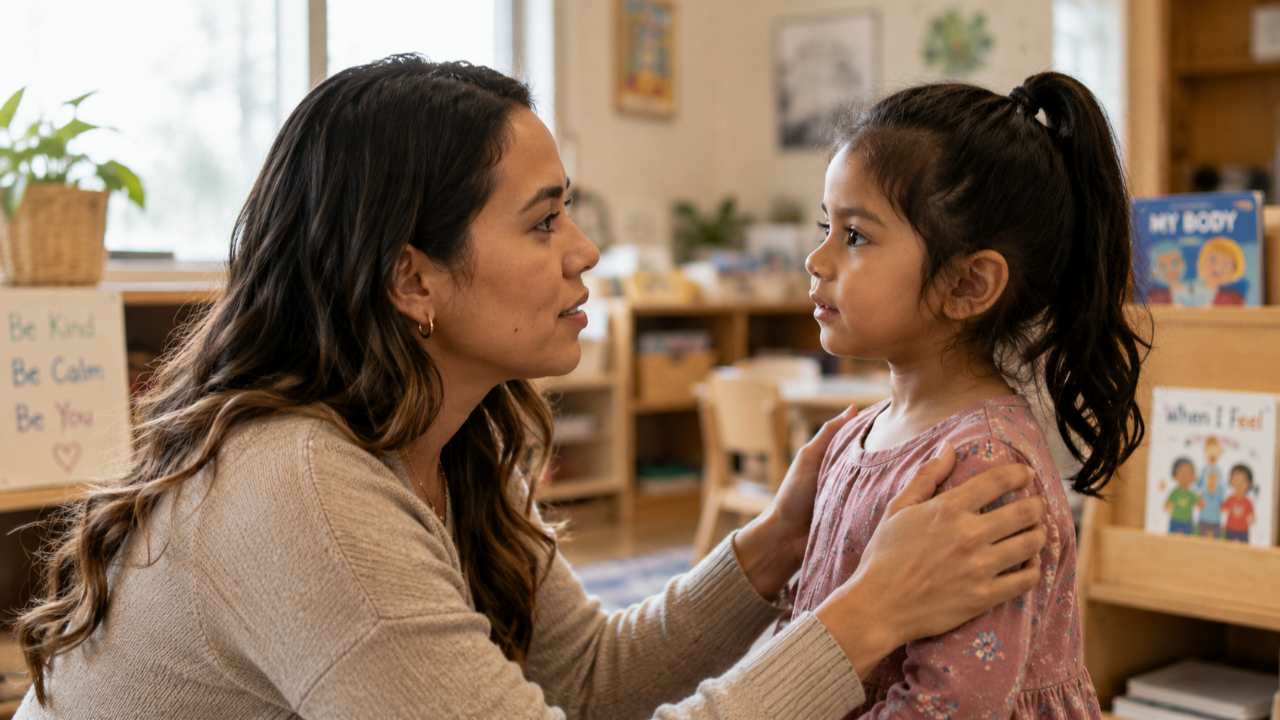
- Get low and get close (if welcomed). Kneeling to a child's eye level, rather than standing over them, changes the whole tone of an interaction. It signals partnership instead of authority. Some children want physical closeness in a big-feelings moment; others need a little space first. Reading which one a child needs, and adjusting, is part of the skill.
- Name the feeling without trying to fix it immediately. "You're really frustrated that the tower fell" does something quietly powerful: it tells a child their internal experience makes sense to someone else. This isn't the same as agreeing that throwing a block is okay. Naming a feeling and holding a boundary can happen in the same breath.
- Use your voice as a regulation tool. A slow, low, steady voice communicates safety in a way that words alone can't. Many teachers find that slowing their own speech down, even artificially at first, has an almost immediate calming effect on a dysregulated child nearby.
- Offer a body-based reset, together. A slow breath modeled out loud ("let's blow out five birthday candles"), a hand on the back, or simply sitting nearby while a child cries it out are all forms of co-regulation. The goal isn't to stop the feeling. It's to keep the child from feeling alone inside it.
- Repair after the storm passes. Once a child has settled, a brief, warm check-in ("that was a big feeling, and you got through it, and I'm proud of how you're breathing now") reinforces that the relationship is intact and that big emotions don't damage the connection between you.
A Common Misconception: "Co-Regulation Means Giving In"
One of the most persistent myths about co-regulation is that it's a permissive, boundary-free approach where every meltdown gets negotiated away. In practice, it's closer to the opposite. Co-regulation works best alongside clear, consistent limits, not instead of them. A teacher can validate a child's frustration ("I know you don't want to clean up yet") while still expecting that clean-up time is happening. The nervous-system support and the boundary aren't in conflict. They actually make each other more effective, because a child who feels understood is more able to accept a limit than a child who feels dismissed.
Co-Regulation Isn't Just for Toddlers
While co-regulation is most obviously visible during toddler and preschool meltdowns, the same principle applies across the elementary years, and honestly, across adulthood too. An anxious eight-year-old before a test, a frustrated ten-year-old mid-conflict with a friend, even a stressed colleague in a staff meeting, all respond to the presence of a calm, regulated person nearby. The strategies simply become more subtle as children get older: a steady tone, a knowing glance, a few quiet words instead of a full physical reset.
Why This Matters Beyond a Single Meltdown
Every co-regulated moment is small on its own. But across a school year, hundreds of these small moments accumulate into something bigger: a child who has genuinely internalized that big feelings are survivable, that trusted adults stay steady, and that they are not alone in the hardest parts of growing up. That's not a soft, secondary outcome. It's the foundation that academic learning, friendships, and long-term wellbeing are all built on top of.
Bringing Co-Regulation Into Your Classroom
If you've read this far, you already have the instinct for this work. Most educators do; it's often the why behind it, and the specific, repeatable moves that turn instinct into a consistent practice, that can be harder to build alone in the middle of a busy day.
That's the space Kind Mind's programs sit in: helping teachers turn what already feels true in their gut into a set of concrete, evidence-based classroom routines, alongside the professional development and family engagement resources that carry the same approach home. If you'd like to see what that looks like in practice, we'd love to have you explore what we've built.
Author